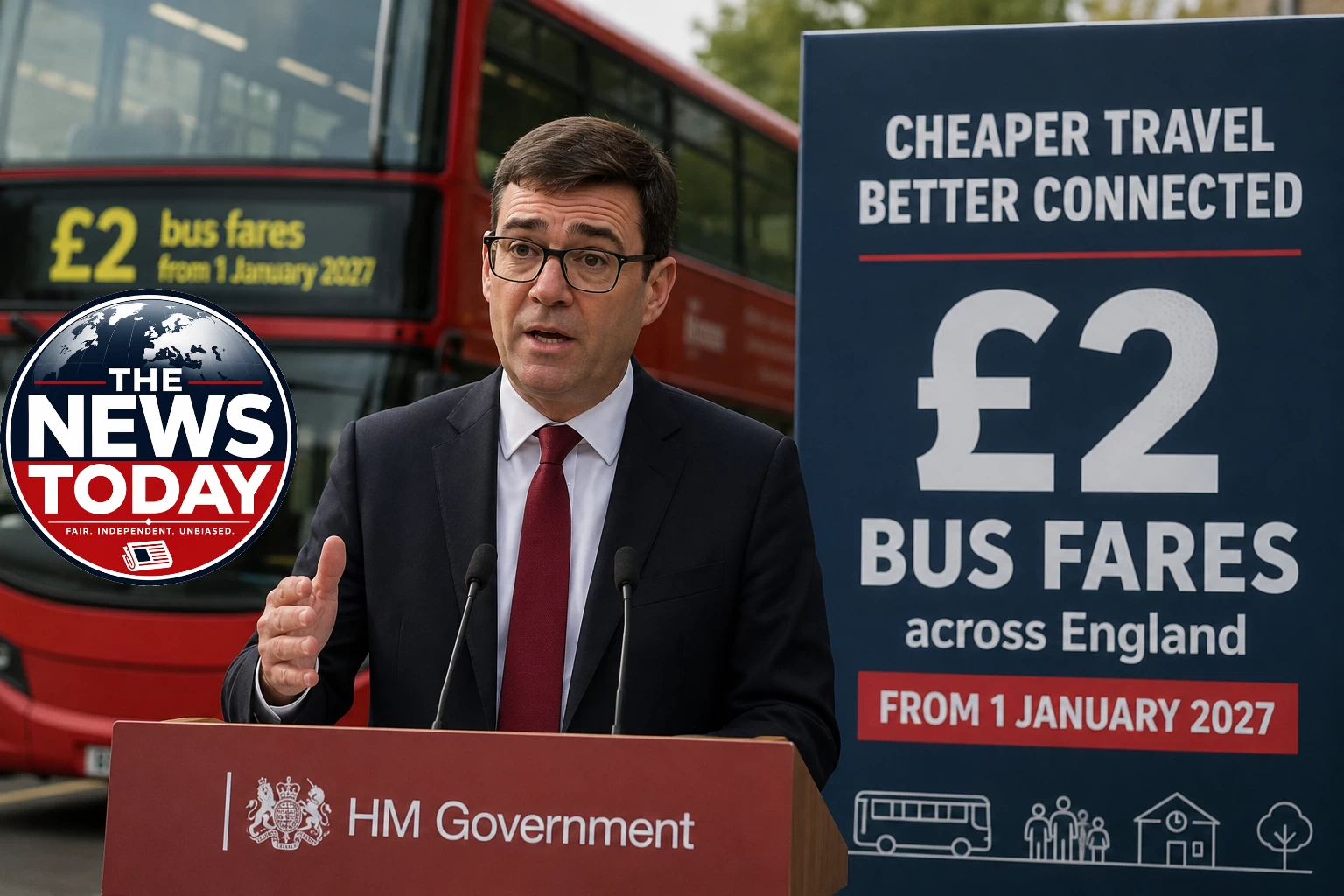
Prime Minister Andy Burnham has announced that single bus fares across England will be capped at £2 from 1 January 2027, marking the second major cost-of-living measure introduced during his first week in office. The move follows the government’s decision to remove VAT from domestic electricity bills, with ministers saying both policies are designed to put more money back into household budgets.
The new fare cap will replace the current £3 maximum single fare on participating bus services across England outside London. The government says the measure will remain in place throughout 2027 and could reduce the cost of many journeys by around one-third.
Announcing the policy, Burnham said affordable transport was essential and argued that nobody should be prevented from accessing work, education, healthcare or leisure because of the price of bus travel. The government believes cheaper fares will particularly benefit people living in rural and coastal communities, where bus journeys can be among the most expensive.
The scheme is backed by more than £500 million in funding, including £400 million from changes to the government’s international climate finance programme, where some grants will instead be provided as loans. Ministers say the remaining funding will come from existing transport budgets and departmental savings.
Government figures suggest the previous £2 fare cap, which operated between 2023 and 2024, resulted in an estimated 30 million additional bus journeys within ten months. Ministers argue that lower fares not only help families with everyday costs but also support local economies by making travel more accessible.
However, the funding mechanism has already attracted criticism. International development organisations argue that diverting climate finance from grants to loans could reduce support for some of the world’s poorest countries. Opposition politicians have also questioned whether the government has fully identified the long-term funding required for the policy.
The bus fare announcement is part of what Burnham has described as a “cost of living government”, with ministers indicating that further measures aimed at easing household financial pressures could be announced ahead of the autumn Budget.
The policy does not apply to London, where bus fares are already set separately by Transport for London, although funding has also been made available for devolved administrations wishing to introduce similar schemes.
▶ Listen to this article Audio narration from The News Today.eu Your browser does not support audio playback. For more than four
More▶ Listen to this article Audio narration from The News Today.eu Your browser does not support audio playback. A Black barrister arriving

MoreFor thousands of years, humanity has divided itself into tribes. By nationality. By race. By language. By class. By territory. But perhaps
More▶ Listen to this article Audio narration from The News Today.eu Your browser does not support audio playback. Every species has its
MoreFor most of my adult life I have been a Labour voter and a member of the Labour Party. That wasn’t simply
More▶ Listen to this article Audio narration from The News Today.eu Your browser does not support audio playback. 1 Is Racism Becoming
MoreIntroduction For much of the past four decades, Britain’s economy has been built around the idea that if those at the top
MoreWhen Andy Burnham walked into Downing Street, he inherited more than an economy under pressure, overstretched public services and a divided country.
MoreWealth Inequality Has Widened Since 2010, Britain has seen the number of billionaires rise from around 50 to well over 150, while
More▶ Listen to this article Audio narration from The News Today.eu Your browser does not support audio playback. Will Andy Burnham’s Latest
More