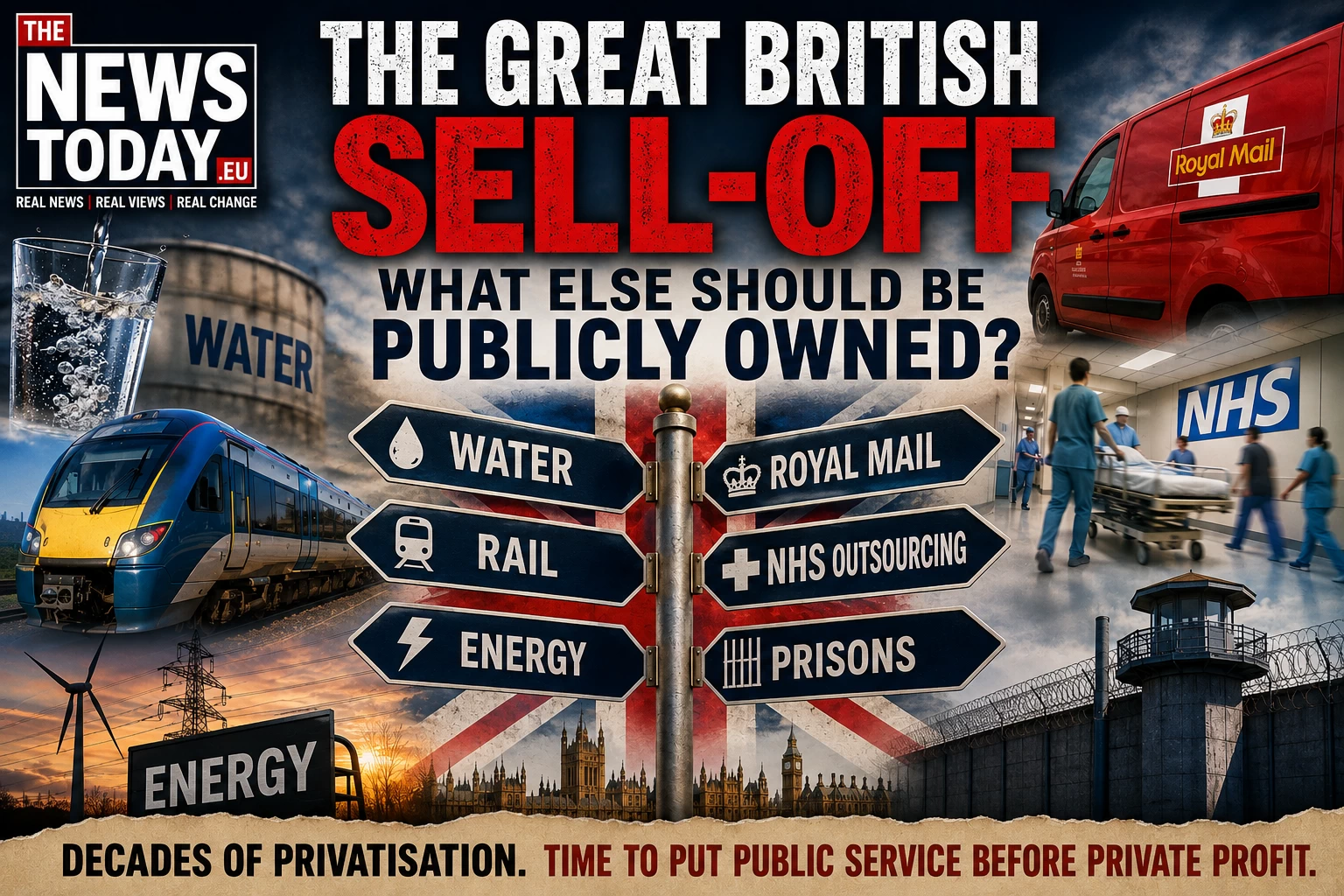

For more than four decades, Britain has conducted one of the developed world’s biggest experiments in privatisation. But as bills rise and essential services struggle, the case for UK public ownership is returning to the political agenda. Water, rail, energy, Royal Mail, NHS outsourcing and prisons all raise the same fundamental question: did Britain sell off services that should never have been for sale?
Water, railways, energy, Royal Mail and numerous public services have been transferred wholly or partly into private hands. The argument was simple: competition would make services more efficient, reduce costs and free taxpayers from the burden of inefficient state industries.
But after decades of privatisation, perhaps we should be asking a different question:
Did Britain sell off things that should never have been for sale?
Water: The Case That Is Becoming Harder to Defend
England’s water industry is perhaps the clearest example of the problem.
Water is not an optional consumer product. Every household needs it, and customers cannot realistically choose between competing networks of pipes.
Yet private water companies have been able to distribute billions of pounds to shareholders while the industry has faced criticism over sewage pollution, infrastructure investment, leakage and rising bills.
If ever there were an argument for public ownership of an essential monopoly, water provides it.
But water is only the beginning.
Rail: Why Should a Natural Monopoly Generate Private Profit?
Britain’s railways have spent decades moving between public and private control.
The fundamental problem with attempting to create a conventional market in railways is obvious: passengers generally cannot choose between several competing railway lines connecting the same towns.
Rail is infrastructure.
A publicly controlled railway could concentrate on reliability, affordability, capacity and economic development rather than ensuring that individual parts of the system generate commercial returns.
Britain has already moved substantially back towards public control. The question now is whether the railway should ultimately be treated primarily as a national public service rather than a commercial opportunity.
Energy: Should Electricity Be Run for Profit?
Few things demonstrate the importance of energy more clearly than the shock caused by soaring household bills.
Electricity and gas are necessities.
Families cannot simply decide to stop heating their homes because prices become unaffordable.
Britain should therefore consider a much larger publicly owned role in energy generation and supply.
Public investment in renewable electricity, nuclear power, storage and the grid could allow the country to plan its energy future strategically.
Instead of asking how much profit can be extracted from Britain’s energy needs, government could ask:
How do we provide secure, affordable and increasingly clean energy for everyone?
Royal Mail: Was Selling It Really Necessary?
Royal Mail was built over generations as a national institution.
Privatisation transformed it into a commercial business operating under pressure to generate returns for investors.
But postal services perform a wider social function.
Someone living in a remote Scottish community should still be able to send and receive post at a reasonable price. Small businesses throughout Britain depend upon reliable deliveries.
A national postal network exists because society needs it—not simply because individual routes are profitable.
That makes the case for treating postal infrastructure as a public service particularly strong.
NHS Outsourcing: Public Money, Private Profit
The NHS remains publicly funded, but large parts of its operation have increasingly involved private contractors.
Private companies may sometimes provide useful additional capacity. The danger comes when outsourcing becomes an ideological objective rather than a practical tool.
Every contract introduces another fundamental question:
Is the taxpayer paying for healthcare—or paying for healthcare plus somebody’s profit margin?
Where services can be delivered efficiently and effectively inside the NHS, there is little justification for automatically outsourcing them.
The guiding principle should be patient care, not creating markets within healthcare.

Prisons: Should Punishment Ever Be a Business?
Perhaps nowhere is the conflict between public responsibility and private profit clearer than prisons.
The state has extraordinary powers over prisoners. It removes their liberty, controls their movements and assumes responsibility for their safety.
Those powers should arguably remain directly accountable to the public.
There is also an uncomfortable contradiction at the heart of private prisons.
A successful justice system should ultimately want fewer people offending and fewer people incarcerated.
A prison business, however, requires prisoners.
That alone should make us question whether incarceration is an appropriate source of private profit.
The Bigger Question
This debate is not really about whether everything should be nationalised.
Restaurants, supermarkets, manufacturers, technology companies and countless other businesses operate perfectly naturally in competitive markets.
The distinction should be between genuine markets and essential monopolies or public services.
When people can realistically choose between competing providers, private enterprise can be enormously effective.
But when citizens cannot reasonably opt out, cannot choose the infrastructure and cannot live without the service, the argument changes.
Our View: Britain Sold Too Much
Britain was promised that privatisation would create a nation of consumers benefiting from competition.
Too often we instead created captive customers.
Water bills must be paid. Homes must be heated. Trains must run. Letters and parcels must reach every community. Patients must receive treatment. Prisons must remain accountable to society.
These are not ordinary commodities.
For forty years Britain has repeatedly asked:
“Can we sell it?”
Perhaps the question for the next generation should be:
“Should we have sold it in the first place?”
The answer is simply no.
References:
- Ofwat — water industry regulation and performance.
- Great British Railways — Britain’s developing publicly owned railway structure.
- Ofgem — energy prices, regulation and the energy market.
- NHS England — NHS structure and services.
- UK Government — official material covering prisons and public policy.

▶ Listen to this article Audio narration from The News Today.eu Your browser does not support audio playback. For more than four
More▶ Listen to this article Audio narration from The News Today.eu Your browser does not support audio playback. A Black barrister arriving
MoreFor thousands of years, humanity has divided itself into tribes. By nationality. By race. By language. By class. By territory. But perhaps
More▶ Listen to this article Audio narration from The News Today.eu Your browser does not support audio playback. Every species has its
MoreFor most of my adult life I have been a Labour voter and a member of the Labour Party. That wasn’t simply
More▶ Listen to this article Audio narration from The News Today.eu Your browser does not support audio playback. 1 Is Racism Becoming
MoreIntroduction For much of the past four decades, Britain’s economy has been built around the idea that if those at the top
MoreWhen Andy Burnham walked into Downing Street, he inherited more than an economy under pressure, overstretched public services and a divided country.
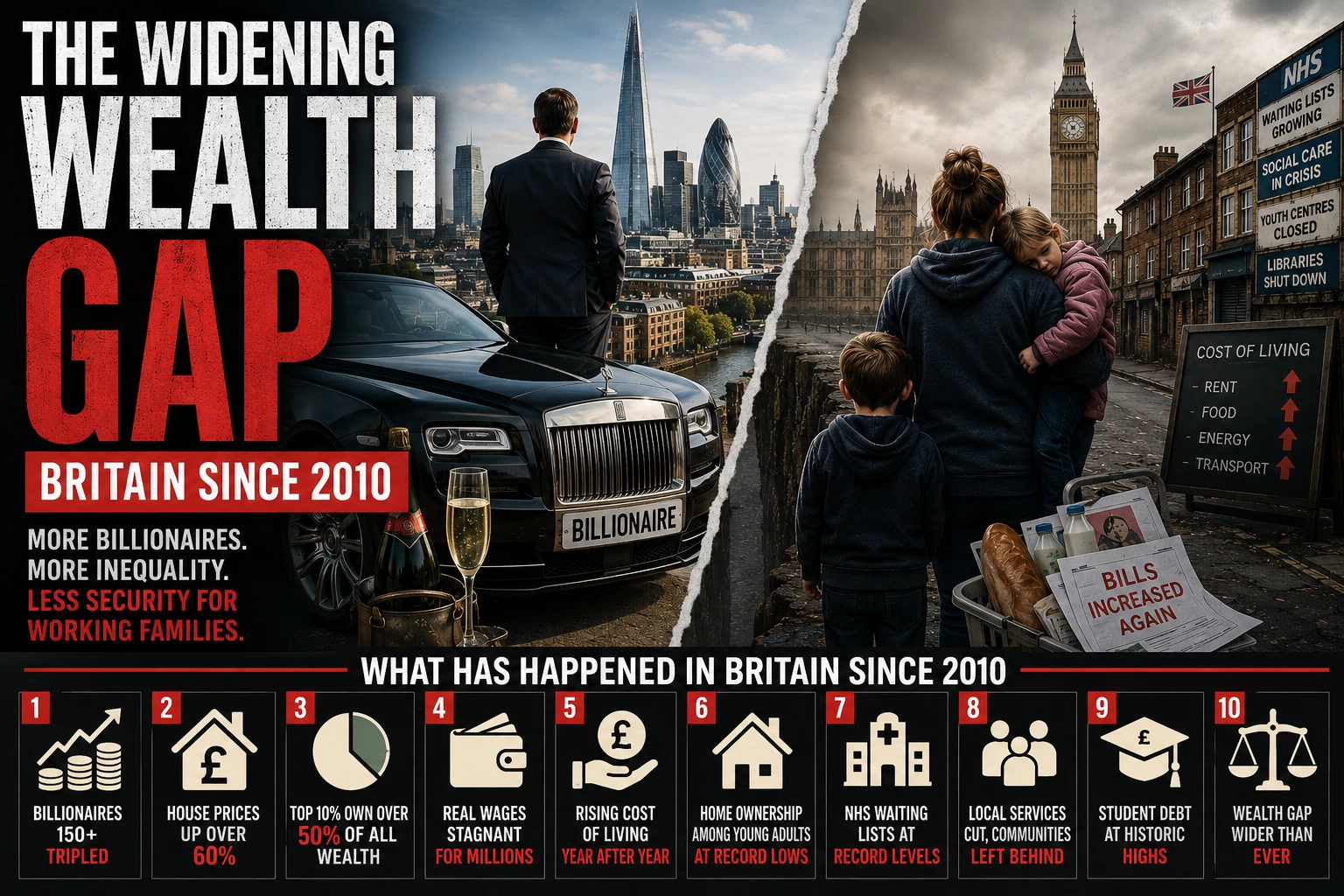
MoreWealth Inequality Has Widened Since 2010, Britain has seen the number of billionaires rise from around 50 to well over 150, while
More▶ Listen to this article Audio narration from The News Today.eu Your browser does not support audio playback. Will Andy Burnham’s Latest
More