
Opinion | TheNewsToday.eu
“Take Back Control.”
Three words that changed Britain’s course forever.
They adorned campaign buses, newspaper front pages and podiums across the country during the 2016 referendum. To millions of voters they represented hope—a belief that leaving the European Union would restore Britain’s prosperity, strengthen democracy and improve everyday life.
Ten years later, Britain is undoubtedly outside the European Union.
But the question that matters is far simpler.
Has Brexit made ordinary Britons better off?
Increasingly, the evidence suggests the answer is no.
The Biggest Losers? The British People
The irony is painful.
Brexit was sold as a revolution for ordinary working people.
Yet those same people appear to have paid the highest price.
Independent economists now broadly agree that leaving the EU Single Market and Customs Union has reduced trade, discouraged investment and slowed economic growth compared with a scenario in which the UK had remained in the EU. The Office for Budget Responsibility continues to estimate that the UK’s current trading arrangements will reduce long-term productivity by around 4%, while more recent academic research has estimated an even larger economic impact.
The consequences are not abstract.
Lower economic growth means:
- lower wage growth
- less money for schools and hospitals
- weaker public finances
- higher borrowing
- reduced living standards.
Britain has endured COVID-19, the energy crisis and global inflation. No serious commentator claims Brexit caused every economic problem.
But Brexit added another weight around Britain’s neck at precisely the moment resilience was needed.
The Promise of Prosperity Never Arrived
Leave campaigners spoke confidently about striking trade deals around the world.
Trade with Europe, they suggested, would continue almost unchanged.
Reality has been rather different.
Thousands of small exporters have simply stopped selling into Europe because customs paperwork, veterinary certificates and border checks have made many transactions uneconomic. Reuters has reported that UK food exports to the EU fell sharply after Brexit and that around 20,000 small firms stopped exporting to the bloc altogether.
For businesses that once traded freely with customers in France, Germany or Spain, Europe became not a neighbour—but a bureaucratic obstacle.
Farmers and Fishermen Were Promised More
No industries were held up as Brexit success stories more than farming and fishing.
Both expected freedom.
Both instead encountered labour shortages, export paperwork and costly delays.
Many fishing businesses discovered that regaining greater control over British waters meant little if their fresh catch could no longer reach European markets quickly and cheaply.
It was one of Brexit’s greatest political symbols.
It has become one of its greatest disappointments.
Young Britain Lost More Than It Realised
One generation voted.
Another inherited the consequences.
Young Britons no longer enjoy automatic freedom to:
- live across Europe
- work in 27 neighbouring countries
- study through Erasmus as before
- retire wherever opportunity takes them.
Previous generations rarely appreciated these freedoms because they had always existed.
Now they are gone.
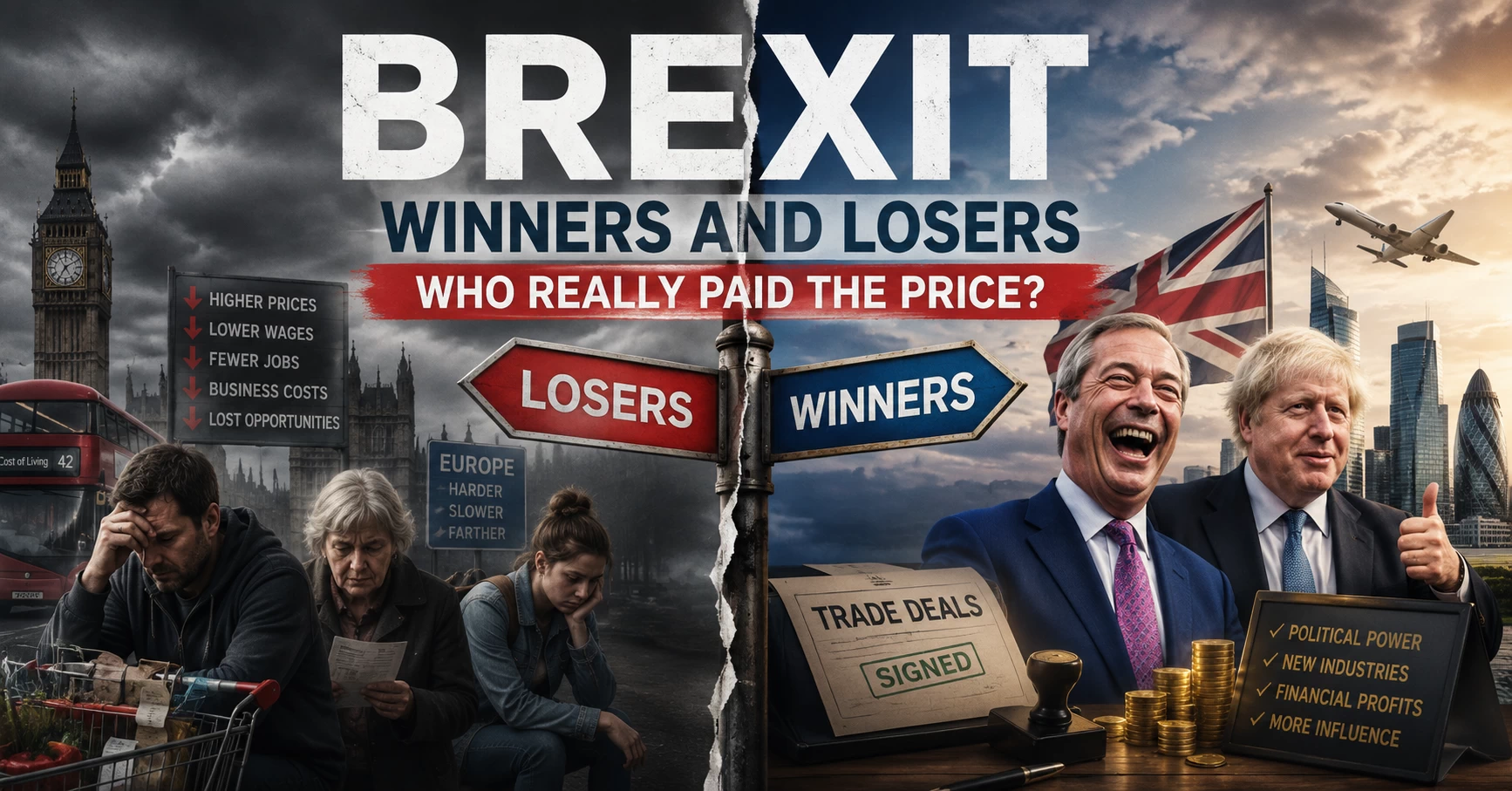
So Who Actually Won?
Every political upheaval produces winners.
Brexit certainly did.
Nigel Farage
No politician gained more personally from Brexit than Nigel Farage. Both politically and financially if we are to believe at least one of his £5 million gift reasons. He stated it was a reward for his work on Brexit. Many would argue that their ‘reward’ was to become poorer.
For decades he fought to remove Britain from the European Union.
Many regarded him as a fringe figure.
Brexit transformed him into one of the defining political personalities of modern Britain.
Today Reform UK sits at the centre of British political debate.
Whether history judges Farage kindly is another matter entirely.
Boris Johnson
Without Brexit there is every chance Boris Johnson would never have entered Downing Street.
Brexit carried him to the Conservative leadership and ultimately to the Premiership.
His political career reached heights unimaginable before the referendum.
Britain, meanwhile, continues to count the economic cost.
The Brexit Bureaucracy Industry
One of Brexit’s least discussed growth sectors has been bureaucracy.
Customs consultants.
Import specialists.
Trade compliance advisers.
Immigration lawyers.
Entire industries now exist simply because Britain created barriers where previously none existed. The Financial Times recently highlighted customs specialists and expanded civil service functions among the unexpected beneficiaries of Brexit.
This is hardly the streamlined economy voters were promised.
Financial Speculators
Sterling’s collapse after the referendum created substantial profits for investors and currency traders correctly positioned before the vote.
Financial volatility always creates opportunities.
Just not for ordinary families buying groceries.
The Cost Nobody Can Ignore
Perhaps Brexit’s greatest failure lies not in economics alone.
It is the loss of trust.
Millions genuinely believed promises that Britain would enjoy all the benefits of leaving while suffering almost none of the costs.
Instead they experienced:
- higher prices
- weaker growth
- stagnant wages
- declining public services
- political instability.
Even many who voted Leave now acknowledge that Brexit has not delivered what they expected.
That does not necessarily mean they regret voting as they did.
But it does suggest that the promises made in 2016 bear little resemblance to today’s reality.
The Real Winners
Looking back over a decade, one uncomfortable conclusion emerges.
The principal beneficiaries appear to have been:
- career politicians
- political movements
- financial speculators
- consultants employed to manage Brexit’s bureaucracy.
The principal losers appear to have been:
- working families
- pensioners
- exporters
- farmers
- young people
- taxpayers.
Those are not the outcomes voters were promised.
TheNewsToday.eu Verdict
Britain had every democratic right to leave the European Union.
That question was settled at the ballot box.
What remains open to judgement is whether the promises made to secure that decision were ever realistic.
History is becoming clearer with every passing year.
Brexit did not unleash the economic renaissance its architects promised.
Instead, it left Britain trading less freely with its largest market, investing less than comparable economies and growing more slowly than many expected. Official forecasters and independent researchers continue to conclude that Brexit has imposed a lasting economic cost on the UK, even if they differ on its exact scale.
Nigel Farage, Boris Johnson and the architects of Brexit may yet argue that sovereignty alone justified the price.
That is a legitimate political argument.
But for millions of households facing squeezed incomes, higher costs and fewer opportunities than they were promised, sovereignty has proved difficult to spend at the supermarket checkout.
The referendum asked Britain to take back control.
The question history will answer is whether Britain first gave away its prosperity.



▶ Listen to this article Audio narration from The News Today.eu Your browser does not support audio playback. For more than four
More▶ Listen to this article Audio narration from The News Today.eu Your browser does not support audio playback. A Black barrister arriving
MoreFor thousands of years, humanity has divided itself into tribes. By nationality. By race. By language. By class. By territory. But perhaps
More▶ Listen to this article Audio narration from The News Today.eu Your browser does not support audio playback. Every species has its
MoreFor most of my adult life I have been a Labour voter and a member of the Labour Party. That wasn’t simply
More▶ Listen to this article Audio narration from The News Today.eu Your browser does not support audio playback. 1 Is Racism Becoming
MoreIntroduction For much of the past four decades, Britain’s economy has been built around the idea that if those at the top
MoreWhen Andy Burnham walked into Downing Street, he inherited more than an economy under pressure, overstretched public services and a divided country.
MoreWealth Inequality Has Widened Since 2010, Britain has seen the number of billionaires rise from around 50 to well over 150, while
More▶ Listen to this article Audio narration from The News Today.eu Your browser does not support audio playback. Will Andy Burnham’s Latest
More